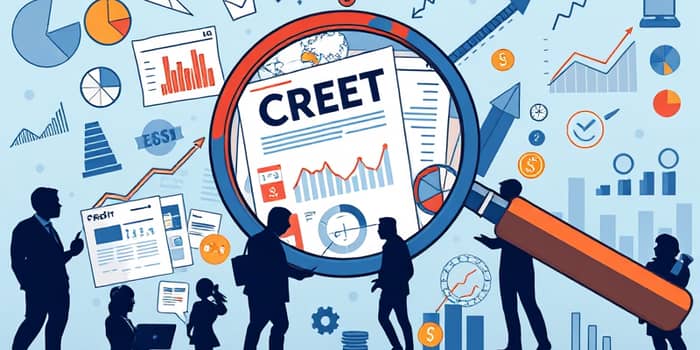
In 2026, the credit landscape stands at a crossroads of cautious advancement and looming uncertainty. As balances climb and consumer protection concerns intensify, an investigative approach is vital to reveal how data trends, systemic errors, and policy battles shape everyday access to credit.
The latest Federal Reserve G.19 figures show total consumer credit flows at 417.7 billion USD in Q4 2025. Credit card balances are projected to reach 1.18 trillion USD by year-end, marking a 2.3% year-over-year credit growth slowdown—the smallest annual increase since 2013, excluding the pandemic dip.
Overall consumer credit rose 2.4% in 2025, compared to peaks of 12.6% in 2023 and 5.7% in 2024. Revolving credit advanced 3.4%, while nonrevolving growth moderated at 2.0%. Despite this deceleration, delinquency rates remain near pre-pandemic levels, reflecting a disciplined underwriting amid ongoing uncertainty.
Credit card APRs for accruing interest eased to 22.30% in Q4 2025, down from 22.83% in Q3. Meanwhile, 82% of Americans report that maintaining or improving their FICO score is a top priority this year, underscoring consumers’ awareness of credit’s role in financial resilience.
Even as average FICO scores climbed 14 points between 2018 and 2023, the credit repair industry grew steadily. Consumers continue to battle persistent credit report errors harming their financial standing. A single derogatory mistake can slash a score by up to 133 points, shifting consumers from “Very Good” to “Fair” status.
Errors range from missing tradelines to incorrect balances. These oversights can lead to higher interest rates, denied refinancing, and delays in securing home equity loans. Reports update every 30 to 45 days, but many assume automatic verification that rarely occurs.
Over 11,000+ Americans turn 65 daily in 2026, each with decades of financial records. Without comprehensive oversight, a small reporting glitch can trap retirees in higher-cost loans or credit denials, revealing a systemic vulnerability.
The corporate credit arena shows mixed signals. S&P Global forecasts 5% to 7% growth in 2026, fueled by post-pandemic M&A activity. Yet inflationary pressures, labor costs, and claim delays threaten credit metrics.
Private credit has surged 50% between 2020 and 2025 to exceed 3 trillion USD, outpacing public high-yield bonds. With a projected climb to 5 trillion USD by 2029, non-depository financial institutions maintain a 23% lending CAGR since 2010.
Fintech lenders captured 71% of new credit card offerings, though their 30+ DPD delinquencies sit above pre-pandemic levels. Traditional banks, bolstered by robust capital and stress tests, remain cautiously optimistic but aware of late-cycle risks.
At the heart of credit accuracy lies tri-merge credit reporting essential for fair assessments. Proposals to replace it with single-bureau systems promise cost savings but risk omitting critical data. This threatens fair lending and penalizes already vulnerable groups.
Litigation around credit reporting soared in 2026. New state laws demand higher accuracy standards, while the CFPB’s recent Consumer Credit Card Market Report highlighted areas ripe for reform. Equifax’s January 2026 trends also underscore shifting debt patterns and regional nuances.
Lenders have a responsibility to adopt rigorous verification, ensuring that errors don’t silently erode consumer trust. Consumers, in turn, must regularly audit reports and leverage dispute tools swiftly.
The credit ecosystem in 2026 balances on a knife’s edge of growth and governance. While trends point to private credit boomed to $3 trillion and stable delinquency rates, underlying vulnerabilities demand action.
Financial institutions should deepen partnerships with responsible borrowers and maintain disciplined underwriting amid ongoing uncertainty. Regulators must safeguard data integrity, and consumers need to remain vigilant, especially seniors with complex histories.
By shining a light through the investigator’s lens, stakeholders can transform the credit landscape into one that rewards accuracy, protects the vulnerable, and fosters sustainable growth. The time to act is now, ensuring that every credit decision rests on a foundation of truth.
References