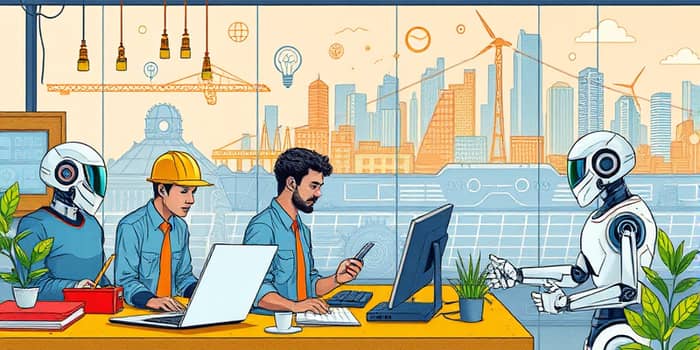
The rapid rise of artificial intelligence and automation is transforming how we work, earn, and innovate. As machines take on routine tasks, and algorithms augment complex processes, businesses and employees face both risks and opportunities. This article examines employment trends, wage shifts, sectoral impacts, and the pathways to thriving in an automated economy.
Since the public release of ChatGPT in 2022, overall U.S. employment has climbed by 2.5%, yet the story diverges in sectors most exposed to AI integration. AI-exposed sectors saw employment declines, with computer systems design falling by 5% and the top 10% of exposed industries contracting 1% overall. Meanwhile, nearly half of all U.S. workers face the risk of automation across various tools.
In the United States, projections suggest 6% of jobs may be fully automated by 2030, and 30% will have significant tasks handled by AI. Although this points to substantial displacement, new roles in designing, implementing, and maintaining AI systems promise a net gain of tens of millions of jobs worldwide.
Despite job contractions in AI-exposed fields, wages have largely held steady, indicating augmentation complements tacit knowledge more than it substitutes expertise. Workers in lower-experience roles did see a 0.28 percentage point drop in wage growth, highlighting the uneven impact of automation.
Corporate investment in AI is surging, with forecasted capital expenditures hitting 2% of GDP ($650 billion) by 2026. At the same time, unemployment is projected around 4.28%, suggesting automation may decouple profit growth from employment. This trend could concentrate gains among firms even as many roles evaporate.
Key financial takeaways include:
As some roles decline, others surge in demand. The Bureau of Labor Statistics forecasts overall U.S. employment growth of 3.1% from 2024 to 2034, adding 5.2 million jobs. Fastest gains are expected in renewable energy, healthcare, and advanced tech.
Beyond industries, occupations such as wind turbine service technicians, solar photovoltaic installers, nurse practitioners, data scientists, and information security analysts are projected to grow by 28.5% to nearly 50% over the decade. These roles highlight how renewable energy roles expanding rapidly and advanced technical positions will underpin future economies.
One critical lesson is that most jobs will transform rather than disappear completely. Nearly 60% of roles will experience significant workflow changes, even if tasks are not fully automated. For workers, proactive reskilling and continuous learning are essential to remain competitive.
Government programs, corporate initiatives, and online platforms are scaling up to meet the demand for new skill acquisition. From coding boot camps to renewable energy certifications, critical need for continuous reskilling is reshaping education and career pathways for millions.
The automation era presents both disruption and promise. While some wage stagnation and displacement are unavoidable, the simultaneous creation of roles in emerging industries offers a counterbalancing force. By investing in people, fostering adaptable skill sets, and encouraging cross-sector collaboration, societies can harness AI-driven growth for broad-based prosperity.
Embrace transformation to thrive in a world where machines handle more routine work, and humans focus on creativity, empathy, and innovation. The future of work is not predetermined—it is shaped by the choices we make today in education, policy, and organizational strategy. Together, we can build an economy that values both human ingenuity and technological progress.
References