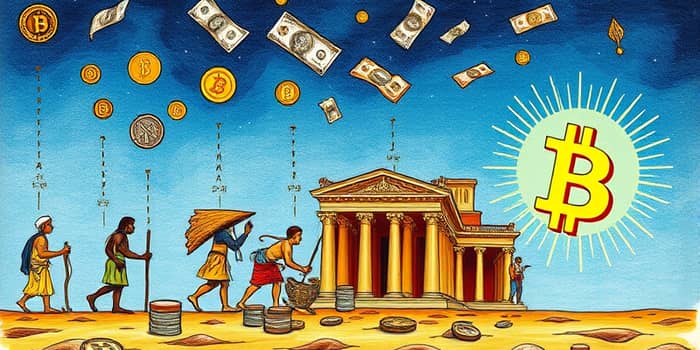
Since the dawn of civilization, people have sought more efficient ways to exchange goods, preserve wealth, and foster trust. Money, in all its forms, has shaped cultures, powered innovation, and defined our collective journey. From simple bartering of grains and livestock to the rise of cryptocurrencies like Bitcoin, each transformation reflects human ingenuity and the relentless quest for better solutions.
Long before coins clinked or banknotes fluttered, our ancestors traded fish for corn or pottery for cloth. While barter worked in small communities, it faced fundamental flaws: no common standard, perishable goods, and difficulty in dividing or transporting large items. Overcoming these boundaries required universal measure of value that all could accept.
The adoption of commodity money addressed many of these issues. Certain items—salt, cattle, cowry shells—gained widespread appeal for being durable, recognizable, and in demand. Yet even these solutions had limits: cattle were hard to transport, and salt could spoil. Nevertheless, the shift marked an essential step toward modern currency.
Yet, even with commodities as intermediaries, traders grappled with issues of trust and storage. Perishable goods decayed; livestock required care. This pressing need for consistency spurred the search for more reliable forms of money, setting the stage for the age of metal currency.
By the 7th century BC, societies sought materials with intrinsic worth that could be easily weighed and authenticated. Metals like gold and silver offered durable, divisible and portable solutions. In Lydia (modern Turkey), electrum coins stamped with a lion head and a punch mark became the first standardized currency, symbolizing trust and authority.
Coins ushered in a global trade and commerce era. Governments minted standardized currency, while traders and travelers embraced portable wealth. Despite occasional debasement—reducing precious metal content to fund wars—coinage endured as the world’s economic backbone for over a thousand years.
During medieval Europe, coinage became both an economic tool and a political statement. Charlemagne’s silver penny unified diverse regions, while later rulers debased coins—reducing precious metal content—to fund wars. Each coin’s imagery symbolized sovereignty, weaving art and authority into everyday commerce.
Paper money emerged in medieval China to lighten the burden of heavy coinage. Merchants deposited coins with trusted agents and received certificates that circulated as currency. These promissory notes represented an innovative leap toward state-backed fiat currency system.
These early bills carried inherent risks, from forgery to loss. In response, states developed advanced anti-counterfeiting security measures—special paper, watermarks, and complex printing—to protect value and reinforce public confidence.
Europe’s adoption of paper notes in the 17th century marked a turning point. The Bank of England issued the first standardized banknotes in 1694, backed by gold reserves and government guarantee. Yet counterfeiting remained rampant, prompting innovations like colored threads and portraiture to protect notes from fraudulent hands.
The 15th century saw banking mature through innovations like double-entry bookkeeping by Luca Pacioli, enabling complex ledgers and credit systems. Central banks emerged, notably the Bank of England in 1694, establishing frameworks for monetary policy and financial stability.
As economies grew, paper notes evolved from mere IOUs into state-backed money without intrinsic value. Governments controlled supply, set interest rates, and managed inflation. Coins and bills bore national icons—leaders, landmarks, symbols—reflecting identity and sovereignty.
The 20th century witnessed the gold standard’s gradual demise, culminating in the United States ending direct convertibility in 1971. Nations embraced purely fiat systems, granting central banks unprecedented power to influence economies through monetary policy. This flexibility has underpinned modern financial stability—and occasional crises.
The late 20th century ushered in digital banking. Electronic transfers, credit cards, and online payments replaced paper checks, setting the stage for a fully dematerialized currency. Amid this shift, Bitcoin emerged in 2009 as the first decentralized digital currency, challenging the notion of central issuance and control.
Powered by blockchain technology, Bitcoin upholds transparency and security through a public ledger of transactions. Its decentralized peer-to-peer network eliminates intermediaries, while a coded supply limit of 21 million coins introduces limited supply of digital assets. Regular halving events reduce new issuance, echoing scarce metals and embedding predictability.
Despite volatility, Bitcoin offers a compelling narrative of innovation and individual empowerment. It invites users to reconsider trust, ownership, and the role of centralized institutions in the economy.
Beyond Bitcoin, a rich ecosystem of cryptocurrencies, stablecoins, and decentralized finance platforms has emerged. Central banks are exploring digital currencies of their own, aiming to combine the efficiency of digital transactions with the trust of state backing. While promising, these innovations carry challenges: cyber threats, regulatory uncertainty, and questions of privacy.
Understanding money’s evolution equips individuals to navigate today’s financial landscape. Here are key takeaways:
By applying these lessons, anyone can build resilience, adapt to emerging trends, and pursue financial sovereignty and empowerment in a rapidly changing world.
From humble barters to digital coins, money’s journey reflects humanity’s drive for progress, trust, and possibility. As we look toward new innovations—central bank digital currencies, decentralized finance, and value systems yet to be imagined—one truth remains clear: our collective creativity will continue to shape what we call money, and in doing so, define the course of history.
References