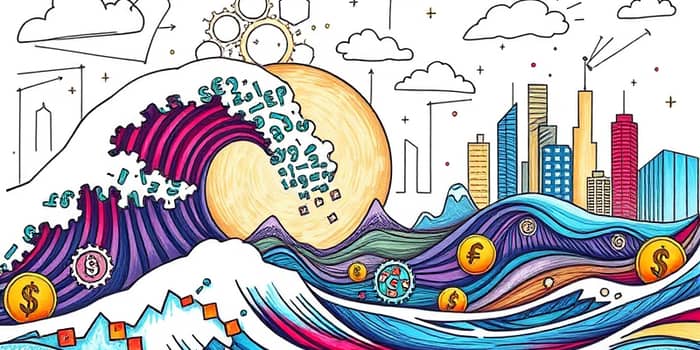
In the vast ocean of the global economy, few forces are as powerful and pervasive as the credit cycle.
This rhythmic ebb and flow of borrowing and lending shapes fortunes, fuels growth, and precipitates crises, making it a critical concept for anyone seeking to understand or navigate financial markets.
At its core, the credit cycle describes the changing availability, pricing, and usage of private sector credit, driven by the interplay between expansionary borrowing and contractionary saving.
By grasping its patterns, you can transform uncertainty into opportunity, riding the waves rather than being swept away.
This article will guide you through the intricacies of the credit cycle, offering practical insights to help you thrive in any economic climate.
The credit cycle unfolds in predictable stages, each with distinct characteristics and implications.
Recognizing these phases is the first step toward mastering economic shifts.
These phases interact with business cycles, often amplifying booms and busts through procyclical financial intermediary balance sheets.
Credit cycles are typically longer, deeper, and sharper than business cycles, making them crucial for long-term planning.
The credit cycle is fueled by specific actors and forces that shape its trajectory.
Understanding these drivers can help you anticipate changes and adapt your strategies.
For example, excessive or accelerated growth with loose criteria can trigger financial crises, as seen in historical events.
Credit expansions often predict lower future GDP growth, highlighting the deep link to the real economy.
Macroprudential policies have evolved to target financial booms, as traditional fiscal and monetary tools may fall short.
Monitoring key indicators can provide early signals of credit cycle shifts, helping you stay ahead of the curve.
These metrics offer valuable insights into economic health and potential risks.
Historically, a one-unit increase in credit spreads correlates with a 1.73% larger peak-to-trough GDP drop, underscoring their predictive power.
By keeping an eye on these factors, you can better navigate economic uncertainties.
Learning from past credit cycles provides a roadmap for the future, with data revealing consistent patterns and outcomes.
For instance, since World War II, the average credit cycle has lasted about 69 months, with expansions often stretching longer.
In crises like the 2007-2009 Great Financial Crisis, credit booms preceded massive spread widening and severe economic downturns.
This table highlights how historical benchmarks can guide expectations during volatile periods.
Recent trends show expansion GDP growth hovering around 2%, lower than historical averages, due to factors like subdued corporate investment.
Understanding these data points helps contextualize current economic conditions and future projections.
For investors, the credit cycle offers both risks and opportunities, depending on the phase and one's awareness of it.
Being stage-aware allows for smarter asset allocation and risk management.
Currently, as of recent analyses, the expansion phase is expected to continue into 2025, with healthy risk appetite and corporate health.
However, leading economic indicators signal potential slowing activity by late 2025 or early 2026, urging caution.
By aligning investments with cycle phases, you can enhance returns and mitigate losses.
In today's economic landscape, applying credit cycle knowledge can empower you to make informed decisions, whether in business or personal finance.
Start by assessing where the economy stands in the cycle using the indicators and drivers discussed.
For individuals, this might mean adjusting savings rates or investment portfolios based on phase shifts.
For businesses, it involves managing debt levels and cash flow to weather potential downturns.
Remember, credit expansions predict lower future GDP growth, so temper optimism with prudence during booms.
Embrace a long-term perspective, as credit cycles teach patience and resilience in the face of economic waves.
By staying informed and adaptable, you can ride these waves with confidence, turning challenges into stepping stones for success.
The credit cycle is not just an economic concept; it's a narrative of human behavior, innovation, and recovery.
Let it inspire you to navigate change with wisdom and courage, building a future that withstands any storm.
References