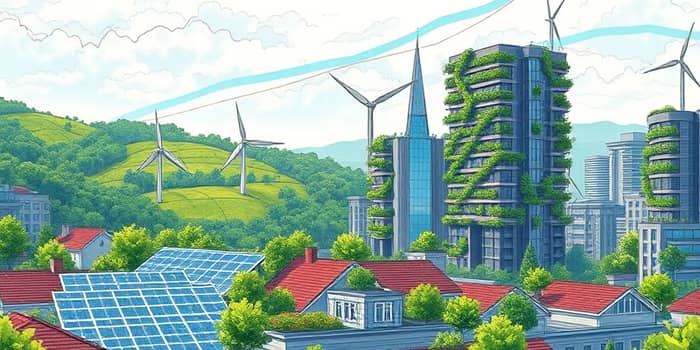
As climate change reshapes our planet, the global economy is pivoting toward sustainable solutions. This article explores the thriving green technology sector, dissecting market growth, investment flows, economic returns, and the urgent gaps that must be addressed. Readers will discover actionable insights to navigate and contribute to this transformative landscape.
The climate adaptation and mitigation markets have experienced an explosive growth of green tech markets in recent years, fueled by rising demand for resilience and clean energy. In 2025, the global adaptation market stood at $35.5 billion and is forecast to surge to $140.82 billion by 2034, achieving a compound annual growth rate of 16.42%. Meanwhile, the broader green economy has already surpassed $5 trillion in annual value and is expected to exceed $7 trillion by 2030.
Adaptation revenues are poised to climb from $1 trillion today to $4 trillion by 2050, with investments rising from $2 trillion to $9 trillion over the same period. These figures underscore the record-breaking investments amid political challenges that define the current climate economy.
Geography plays a pivotal role in shaping green finance flows. Asia Pacific leads the charge, capturing nearly half of global energy transition spending. China alone invested $659 billion in clean energy in 2024, representing over 60% of new renewable capacity additions through 2030.
Fossil fuel supply investments declined for the first time since 2020, while nascent sectors like hydrogen and nuclear experienced temporary funding reductions. These trends emphasize the shift toward resilient infrastructure for sustainable growth across regions.
Investing in adaptation and mitigation generates compelling returns. Studies show that every $1 invested in climate adaptation can yield up to $5 in avoided losses, with some ten-year projects delivering more than $10 in benefits. A portfolio of 320 projects, totaling $133 billion across twelve countries, has already produced $1.4 trillion in economic gains—equivalent to a 27% annual return.
Such outcomes illustrate the massive economic benefits and job creation that arise from strategic climate investments, reinforcing the imperative to channel capital into sustainable projects.
Despite its promise, the climate economy faces significant obstacles. Since 2000, weather-related disasters have caused $3.6 trillion in damages, doubling in cost compared to the early 2000s. Companies failing to adapt risk losing 7.3% of annual earnings by 2035, with potential EBITDA impacts of up to 25% by 2050.
Addressing these disparities demands urgent finance gaps and climate risks to secure resilient communities and safeguard economic stability.
Looking toward 2026 and beyond, the green economy remains resilient. Despite geopolitical headwinds—such as tariffs and regulatory shifts—investors continue to prioritize energy security, digital infrastructure, and supply chain decarbonization.
Key questions persist: How rapidly can renewable capacity scale to meet surging electricity demand? What impact will mechanisms like the EU Carbon Border Adjustment have on global trade? As anticipation grows around next-generation batteries, grid technologies, and carbon capture, the path from hype to execution becomes clearer.
To achieve net-zero targets, stakeholders must recognize that net-zero goals require bold action. Governments, corporations, and financial institutions must close the adaptation gap, enhance policy frameworks, and incentivize private capital toward transformative climate projects.
By leveraging data-driven strategies, harnessing technological innovation, and forging public-private partnerships, we can mold a future where economies thrive in harmony with the environment. The climate economy offers not only a pathway to sustainability but also transformative impact on communities and ecosystems, ensuring prosperity for generations to come.
References