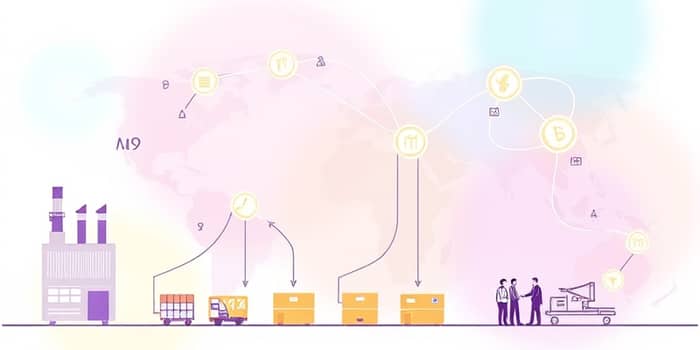
In today's fast-paced global economy, supply chains are more complex and interconnected than ever before.
Yet, they often remain shrouded in opacity, leading to inefficiencies, fraud, and a lack of trust among stakeholders.
Blockchain technology emerges as a revolutionary force, offering a pathway to unprecedented clarity and integrity.
By leveraging its decentralized digital ledger, businesses can transform their operations from chaotic webs into streamlined, transparent ecosystems.
This isn't just about tracking products; it's about building a foundation of trust that empowers every participant, from manufacturers to end consumers.
Imagine a world where you can trace a product's journey from its origin to your hands with a simple scan.
That vision is becoming a reality, driving innovation and fostering ethical practices across industries.
This article delves into how blockchain is reshaping supply chain management, providing practical insights and inspiration for those looking to harness its power for a brighter, more accountable future.
At its core, blockchain functions as a distributed, immutable record-keeping system.
It operates across a network of computers, ensuring that no single entity has control over the data.
This setup creates a shared, tamper-proof source of truth that all authorized parties can access in real-time.
Every transaction, from a shipment dispatch to a quality check, is recorded in timestamped blocks.
These blocks link together chronologically, forming a secure chain that prevents retroactive alterations.
The result is an end-to-end audit trail that eliminates information silos and reduces reliance on intermediaries.
Key mechanisms include consensus protocols and cryptographic hashing, which work together to validate data integrity.
By doing so, blockchain addresses common challenges like fraud risks and regulatory pressures head-on.
It transforms supply chains from opaque, manual processes into transparent, automated networks.
This shift not only enhances operational efficiency but also builds a culture of collaboration and accountability.
Blockchain brings a multitude of advantages that directly impact transparency and overall management.
These benefits collectively create a more resilient and responsive supply chain ecosystem.
The practical implementation of blockchain involves several key components that drive transparency.
By addressing challenges like human errors and multi-stakeholder complexity, blockchain paves the way for smoother operations.
Across various sectors, blockchain is already making a tangible impact on supply chain transparency.
These examples highlight how blockchain is not a distant future concept but a present-day solution.
Despite its benefits, implementing blockchain in supply chains comes with certain hurdles.
Initial setup costs and technological integration can be significant barriers for many organizations.
However, the long-term savings from efficiency gains, such as reduced administrative overheads, often outweigh these investments.
Adoption requires network consensus among all stakeholders, which can be challenging to achieve.
To overcome this, fostering collaboration and demonstrating clear value through pilot projects is essential.
Regulatory alignment and standardization efforts are also crucial to ensure seamless interoperability.
By addressing these challenges proactively, businesses can unlock the full potential of blockchain for transparency.
Looking ahead, blockchain is poised to become a cornerstone of modern supply chain management.
Integration with emerging technologies like artificial intelligence and the Internet of Things will further enhance its capabilities.
This combination will enable predictive analytics for risk management and deeper insights into environmental, social, and governance metrics.
Driven by rising consumer demand for ethics and sustainability, adoption is expected to accelerate across industries.
Blockchain will reshape supply chains for greater efficiency, sustainability, and competitive advantage.
It empowers all stakeholders, from suppliers to end-users, by providing a shared ledger that fosters trust and innovation.
As we move forward, embracing this technology can lead to a more transparent, accountable, and resilient global economy.
By leveraging these benefits, companies can not only improve their operations but also contribute to a more ethical and sustainable world.
Blockchain's role in supply chain management is a testament to how technology can drive positive change.
It invites us to reimagine transparency not as a challenge, but as an opportunity for growth and connection.
As you consider integrating blockchain into your supply chain, remember that every step toward clarity is a step toward a better future.
References