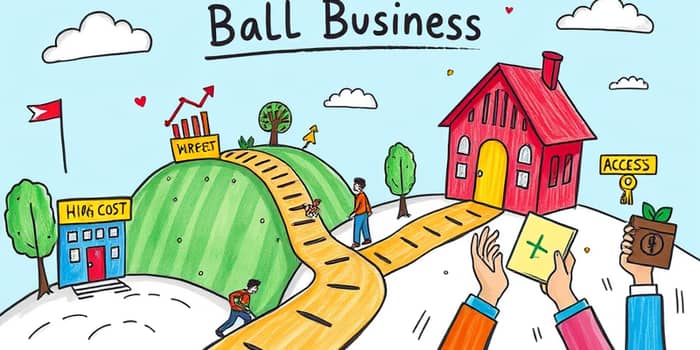
Small businesses are the lifeblood of economies, driving innovation and creating jobs.
Yet, accessing credit remains a pivotal challenge, intertwined with both hurdles and hopes.
Navigating this landscape requires insight into a complex web of challenges and prospects.
From soaring costs to emerging opportunities, the credit environment is evolving rapidly.
This article explores key statistics, trends, and tools to empower entrepreneurs.
It aims to provide practical guidance for leveraging credit effectively.
Resilience and readiness define small businesses in today's market.
Understanding credit dynamics can unlock growth and ensure stability.
Recent data highlights a story of transformation and tenacity.
For instance, 79% of small businesses use business credit cards for operations.
Average monthly spend has surged dramatically over recent years.
This reflects an increasing reliance on credit for daily management.
Lending trends show mixed signals, with growth in some areas.
Year-over-year increases contrast with year-to-date declines in borrowing.
Delinquencies have seen slight drops, but revenue fluctuations persist.
This table underscores critical metrics that shape financial decisions.
It provides a snapshot of the credit landscape today.
Access to credit remains a significant barrier for many entrepreneurs.
Stable application rates often hide lower approval levels.
Startups and minority-owned firms face additional obstacles.
Women-owned businesses, comprising 20% of small employer firms, report more challenges.
Cash flow issues are exacerbated by rising costs.
High expenses from online lenders add to the burden.
Rates can range from 14% to 99%, making credit costly.
Delinquencies and defaults have decreased slightly, but revenues often dip.
Post-pandemic shifts have rebounded traditional funding sources.
Online lenders are growing for small-dollar credit needs.
This creates a diverse but complex financing ecosystem.
Despite challenges, credit offers powerful tools for expansion and stability.
Business credit protects personal assets and secures better rates.
It can lower insurance premiums and aid in supplier talks.
For example, SBA CAPLines can reach up to $5 million.
Guarantees of 75-85% make them attractive for risk-sharing.
The SSBCI program has enabled $3.1 billion in new financing.
Interest rates vary, but strategic use mitigates costs.
Growth expectations are high, with 79% anticipating revenue increases.
Female-owned businesses are more active in seeking credit.
26% take new lines vs. 21% for male-owned firms.
This highlights proactive approaches to financing.
The outlook for 2025-2026 is promising and dynamic.
A lending surge is expected with potential Fed rate drops.
23-26% of businesses plan to access new credit for growth.
Policy support aims to expand programs like SSBCI.
Small businesses are described as resilient and ready.
They are poised for growth despite tariffs and inflation.
Optimism remains steady, with 74-80% of leaders positive.
This confidence fuels investment and innovation.
To harness credit effectively, adopt a strategic approach.
Combine tools like credit cards, lines, and SBA loans.
Build business credit early to secure better terms and access.
Real-world examples show success with these strategies.
Businesses use lines for unexpected orders or seasonality.
Ramp savings example: over $10 billion saved through automation.
This demonstrates the power of efficient credit management.
Monitor credit scores for insights into financial health.
Use credit for operations and expansion, not just emergencies.
Prepare thorough financials for vetting by lenders.
This preparation increases approval chances and terms.
In conclusion, small business credit is a double-edged sword.
It presents unique challenges and vast opportunities for growth.
By understanding the landscape, entrepreneurs can navigate wisely.
The future is bright for those who adapt and innovate.
References