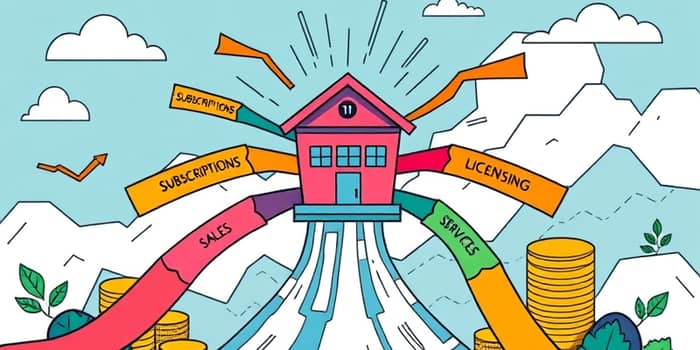
Understanding and optimizing revenue streams is critical for every business aiming to thrive in a competitive market. By dissecting the mechanisms behind each income source, leaders can build a resilient financial foundation and pursue scalable growth paths.
In this comprehensive guide, we explore key revenue categories, examine real-world examples, outline methods to assess predictable and stable income flows, and unveil strategies to unlock long-term expansion. Whether you run a startup or an established enterprise, these insights will fortify your planning and decision-making.
Revenue streams refer to the diverse sources of income a business generates. They are broadly classified as operating and non-operating, each with unique characteristics affecting sustainability and growth potential.
Below is a comparison of the main types, their stability factors, and growth outlook:
Examining industry leaders helps illustrate how multiple streams combine into robust portfolios. Below are examples of companies harnessing diverse revenue models:
Each of these organizations leverages a hybrid approach to mitigate risks associated with relying on a single income source. By diversifying, they achieve greater investor confidence and operational resilience.
Sustainability hinges on predictability and stability, which can be evaluated using a few core metrics:
Subscription and membership-based models typically excel in forecasting revenue and retaining users, allowing for more precise budgeting and strategic planning.
To further illustrate stability considerations, compare transactional and recurring streams side by side:
Expansion prospects are assessed by analyzing growth rates, sensitivity to market shifts, and the ability to scale efficiently. Key methods include:
Market projections underscore the power of subscriptions, set to reach $1.5 trillion by 2025, and licensing at a 4.5% CAGR through 2031. Capitalizing on these trends requires strategic diversification and a strong analytics foundation.
To build a robust revenue architecture:
1. Identify and categorize all current income streams.
2. Calculate projected volumes and pricing for each stream.
3. Monitor key metrics like MRR, churn rate, and customer lifetime value.
4. Use scenario planning and sensitivity analysis to forecast outcomes.
5. Continuously gather feedback and adjust strategies based on data.
By combining these analytical frameworks with proven growth tactics, businesses can achieve a balanced portfolio of income sources that supports both stability and expansion.
Whether you are refining an existing model or launching a new venture, focusing on sustainability and growth potential will ensure your revenue streams remain resilient and prosperous for years to come.
References