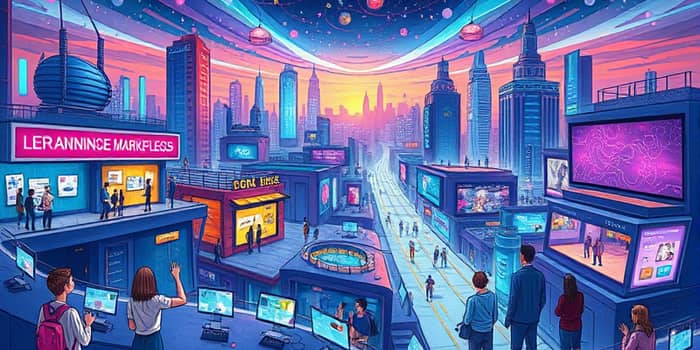
The metaverse is no longer a distant vision; it is rapidly becoming an integral part of our economy and daily lives. As enterprises, creators, and communities converge in these digital realms, they unlock unprecedented scale and opportunity to reshape commerce, social interaction, education, and beyond.
By understanding the market dynamics, technological enablers, and practical strategies, stakeholders can harness this transformation to drive innovation and generate tangible returns.
Valued between $82 billion and $95 billion in 2023, the metaverse industry is projected to surge to $1.3 trillion by 2032. Conservative estimates still anticipate a Compound Annual Growth Rate (CAGR) above 46%, indicating robust expansion.
By 2035, some forecasts foresee the market eclipsing $7,000 billion, fueled by virtual assets, immersive commerce, and enterprise adoption. Analysts highlight a potential to generate USD 5 trillion in value across e-commerce, learning, advertising, and gaming sectors by 2030.
Gartner predicts that by 2026, one quarter of the global population will spend at least one hour daily in the metaverse. This time will be devoted to shopping, working, learning, and socializing in persistent, shared virtual environments.
Meanwhile, 30% of businesses are expected to launch metaverse-ready products and services by 2026, marking the beginning of the commercial adoption era. After a phase of technological groundwork through 2025, we will witness a shift from experimentation to large-scale performance.
The convergence of advanced technologies is creating the foundation for a vibrant digital economy. Key features include:
As spatial computing and digital twins integrate physical and virtual assets, businesses can model real-world processes, enhancing collaboration and innovation.
By 2030, virtual real estate, avatars, digital wearables, and tokenized collectibles are projected to dominate value creation. These assets underpin a thriving economy where scarcity, provenance, and customization drive demand and innovation.
Digital currencies and payment tokens facilitate seamless transactions across global platforms, while subscription and pay-to-own models redefine access and ownership.
Metaverse marketplaces span B2C, C2C, and enterprise models. Creator-focused platforms allow artists to monetize directly, while branded stores bridge physical and digital retail.
Interoperable avatars and digital wallets unlock VR shopping experiences that surpass conventional e-commerce, offering interactive showrooms, live demos, and personalized recommendations within 3D spaces.
Across sectors, the metaverse is driving strategic transformations:
For brands and enterprises, the metaverse offers multiple avenues for growth and engagement:
Aligning with gaming platforms and leveraging blockchain-native apps can accelerate adoption and unlock new revenue models.
As the metaverse matures, regulators worldwide are crafting frameworks for taxation, consumer protection, and IP rights. By 2030, we anticipate cohesive policies that support innovation while safeguarding participants.
Looking ahead, the integration of virtual and physical economies will drive blended virtual and physical economies, transforming commerce, work, and social interactions. Challenges remain, from infrastructure scaling to standardization, but the potential rewards are immense.
In this era of rapid digital expansion, organizations and individuals who embrace the metaverse with vision and agility will shape the next chapter of human connection and economic growth.
References