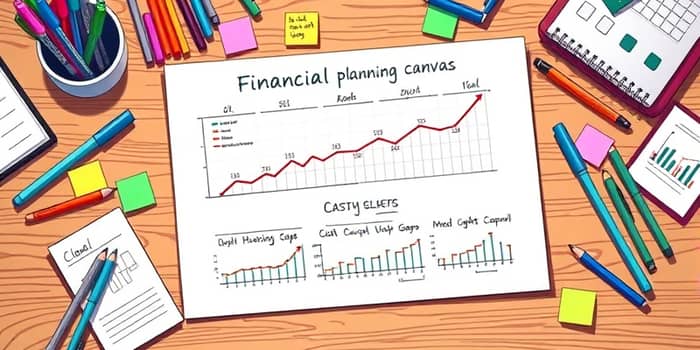
The Cash Flow Canvas transforms complex financial data into an intuitive visual map, empowering business owners and entrepreneurs to plan, forecast, and grow with confidence.
Every business lives and dies by its ability to generate and manage cash. While profit on paper can look healthy, an empty bank account signals real trouble. Understanding net inflows and outflows over time is essential to maintaining operations, investing in growth, and ensuring long-term stability.
Traditional spreadsheets often hide critical patterns in rows and columns. The Cash Flow Canvas simplifies this by offering a visual, one-page financial planning tool that shines a light on where every dollar comes from and where it goes.
The first Cash Flow Canvas emerged as a template from business.gov.au, designed to give small enterprises a fast, accessible way to simplify cash flow management. By filling in dates, sales and expense items, users see immediate totals, taxes owed, and net assets over any period.
Building on this foundation, Nail The Numbers introduced a structured system—Cashflow Canvas™—with eight interconnected blocks. Bootcamps led by certified trainers guide founders through a process to brainstorm in a sketchbook before spreadsheets, refine assumptions, and color-code forecasts for a complete, bank-balancing picture.
At its heart, the original template helps answer four pivotal questions that every business owner must consider. These questions focus on profitability, commitments, spending capacity, and long-term progress.
By gazing at these figures side by side, business owners gain a clear view of both short-term operations and long-term health.
For forecasting-focused planning, the Cashflow Canvas™ System breaks cash flow into eight essential blocks that guide strategic thinking and detailed projections.
This method ensures each dollar is accounted for in sequence, allowing founders to balance every dollar through forecasting and prevent surprise shortages.
Beyond the Canvas, understanding fundamental cash flow components is vital. Cash flow divides into three categories:
Analysts use different measures—nominal, real, free cash flow (FCF), and cash flow to equity (FCFE)—to evaluate performance and compare across periods or peers.
By folding these principles into the Canvas, entrepreneurs can make strategic decisions on revenue and costs with deeper context, adjusting for inflation and lifecycle stages.
Implementing the Cash Flow Canvas follows three key stages:
1. Ideate: Start by dumping all revenue ideas, cost drivers, and timing assumptions onto a physical sketchbook. This early stage encourages creativity and highlights connections before numbers get locked into formulas.
2. Load the Palette: Transfer sketches into the Canvas grid, grouping sales items, cost categories, and tax liabilities. Use dropdowns or color-coding to indicate GST or withholding amounts.
3. Fill the Forecast: Move refined inputs into a comprehensive spreadsheet. Color-coded blocks align with the eight building blocks, ensuring each cash inflow matches a corresponding outflow or reserve. This keeps your bank balance positive and your plan actionable.
The Cash Flow Canvas has powered countless startups, scale-ups, and established businesses to:
Case studies from bootcamps show participants leaving with a one-page plan that aligns sales targets, cost structures, and growth milestones for the next 12 months.
To get the most from your Canvas:
Mastering your money flow unlocks the power to steer your business with foresight. The Cash Flow Canvas unites creativity, strategy, and rigor in a single page, making financial planning not just accessible but truly empowering. Start sketching today, refine your numbers tomorrow, and watch your vision become a sustainable reality.
References