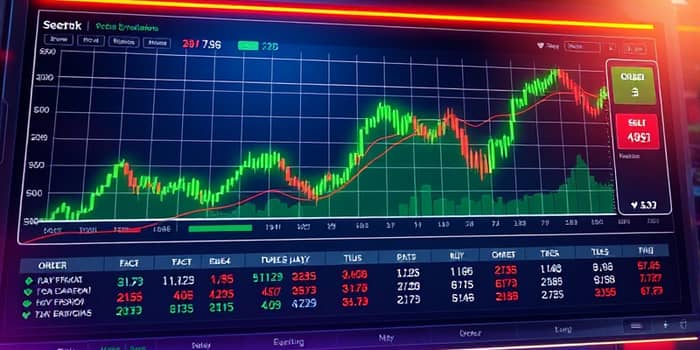
In the fast-moving realm of cryptocurrencies and tokenized assets, traders face a constant battle against price swings and execution risks. To excel, one must peer behind price charts and explore the hidden world of orders waiting to be filled.
Market depth offers that crystal-clear snapshot of supply and demand, empowering traders to navigate volatility with confidence. By decoding depth, you unlock the secrets of liquidity and build a stronger trading edge.
At its essence, market depth refers to a market's ability to sustain large orders without causing drastic price changes. It is a measure of how much volume is available at various price levels in an order book.
In digital assets, depth manifests as a real-time list of buy and sell intentions. Understanding this layer reveals the market's ability to sustain large orders even during high-volume trades, making it a cornerstone of informed decision-making.
Market depth relies on the interplay of bids and asks, the bid-ask spread, and the distribution of order sizes. Each component tells a story about the strength and fragility of the market.
This table highlights how bids and asks form the backbone of liquidity. By examining order sizes, traders gauge whether the market can absorb sizable trades without slipping sharply.
Depth charts graphically display cumulative bids on one side and cumulative asks on the other, using green and red curves. These charts create a supply-and-demand profile, making it easy to spot price regions with heavy support or resistance.
Order books present granular details: individual buy and sell orders sorted by price. Hovering over each level reveals quantity and total value, offering visibility into pending orders and liquidity as it shifts moment by moment on platforms like Binance or Coinbase Pro.
Several elements shape market depth. Core factors include overall trading volume, the tightness of the bid-ask spread, distribution of order sizes, presence of dedicated market makers, and the regulatory framework governing exchanges.
High-volume pairs such as BTC/USDT typically exhibit deep order books, while obscure tokens on low-liquidity venues show shallow depth. Regulatory clarity and competitive markets encourage liquidity providers to post orders continuously, further bolstering depth.
Liquidity and depth are inseparable: markets with substantial depth offer high liquidity and enable large trades at predictable prices. Conversely, shallow books magnify price slippage, dragging execution prices unfavorably during big orders.
Under thin depth, even modest buys or sells can trigger sharp moves, amplifying volatility. In such conditions, traders often face significant price slippage during trades, eroding potential profits and increasing emotional stress during execution.
These practical advantages help traders refine entry and exit points, improving both confidence and consistency in their approach.
Adapting these strategies to depth data can illuminate hidden opportunities often missed by price-chart–only analyses.
Despite its power, market depth is not infallible. Data may be incomplete in over-the-counter or low-liquidity venues, masking true supply-demand dynamics under the surface.
Rapid shifts in volatile crypto markets can overwhelm the most seasoned traders. Meanwhile, manipulation tactics like spoofing and order book layering can create deceptive signals that vanish before execution.
Finally, depth reflects only current limit orders, not the intentions of market participants. Future market-moving events remain unpredictable, underscoring that depth analysis should integrate with broader risk frameworks.
Successful traders blend depth readings with technical indicators and fundamental research. Begin with assets known for reliable liquidity, then watch for widening or narrowing spreads as early warnings of shifting momentum.
Combine limit orders with protective stops and size positions to match observed depth. By layering entries around deep order clusters, you can mitigate slippage in volatile conditions and lock in more favorable execution prices as you refine your trading plan.
Market depth unveils the hidden layers of liquidity that drive price formation. By mastering order book dynamics, depth charts, and the interplay of bids and asks, traders can transform noise into actionable insights.
Incorporate depth analysis into your toolkit to elevate decision-making, manage risk effectively, and seize opportunities concealed within the ebb and flow of digital asset markets. Let these insights guide you toward more informed, confident, and resilient trading.
References