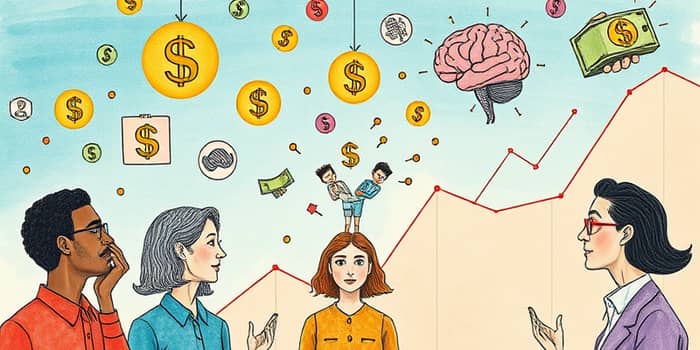
In today’s evolving financial landscape, understanding the inner workings of borrower behavior is more crucial than ever. Traditional credit models rely heavily on financial history, but modern insights reveal that personality and psychology can predict repayment with remarkable accuracy.
Researchers have identified key characteristics that consistently forecast a borrower’s ability to repay debt.
Among the most predictive are:
Empirical studies from Mongolia to Peru confirm that high scorers on these dimensions repay loans more reliably, even in low-income cohorts.
Traditional credit scoring often excludes thin-file or unbanked consumers. Psychometric credit scoring bridges this gap by evaluating traits through standardized tests.
Developed after the seminal 2006 EFL methodology, these models achieve up to 91% accuracy in default prediction. FinTech platforms in over 50 countries implement them to grant loans where no financial record exists. By capturing underlying behavioral tendencies, lenders can extend credit to trustworthy borrowers, boosting financial inclusion without compromising repayment performance.
Beyond traits, the feeling of ownership over debt shapes borrowing decisions. When money is framed as “credit” rather than a “loan,” borrowers report a stronger sense of personal debt ownership.
This phenomenon explains why credit card limits often lead to more spending: borrowers treat available funds as if they already belong to them. Experimental research indicates that a mere shift in terminology can alter application rates and credit searches, highlighting the power of language in financial contexts.
No profile is complete without accounting for cognitive distortions. Two biases stand out:
Neuroscientific studies reveal that lenders’ decisions are also swayed by subconscious reactions to borrower facial cues, activating reward centers in the brain. Recognizing these influences enables financial institutions to design fairer, more objective lending processes.
Context shapes perception. When debt is presented in structured, transparent terms, applicants feel less discouraged. Financial education paired with clear framing reduces dropout rates in loan applications.
For instance, labeling repayments as “scheduled contributions” rather than “monthly installments” increases borrower comfort and commitment. Such subtle adjustments demonstrate that credit behavior can be guided by thoughtful communication strategies.
The integration of behavioral insights into credit assessment has evolved rapidly over two decades. From the earliest psychometric profiling at the EFL center in 2006 to widespread use by digital lenders today, the shift bridges economics and psychology.
Conscientiousness and self-control show universal predictive power, validated across cultures. Meanwhile, cultural nuances—such as local attitudes toward debt—underscore the need for adaptive models.
Translating insights into action empowers both sides of the credit relationship.
By adopting these practices, financial institutions can foster trust, and borrowers can build stronger, more sustainable credit histories.
The intersection of psychology and credit offers a transformative path forward. By acknowledging individual differences in personality, cognition, and context, we unlock new possibilities for responsible lending and empowered borrowing.
As we continue to refine these methods, the promise is clear: a more inclusive, empathetic financial system where insight-driven strategies pave the way to shared prosperity.
References